

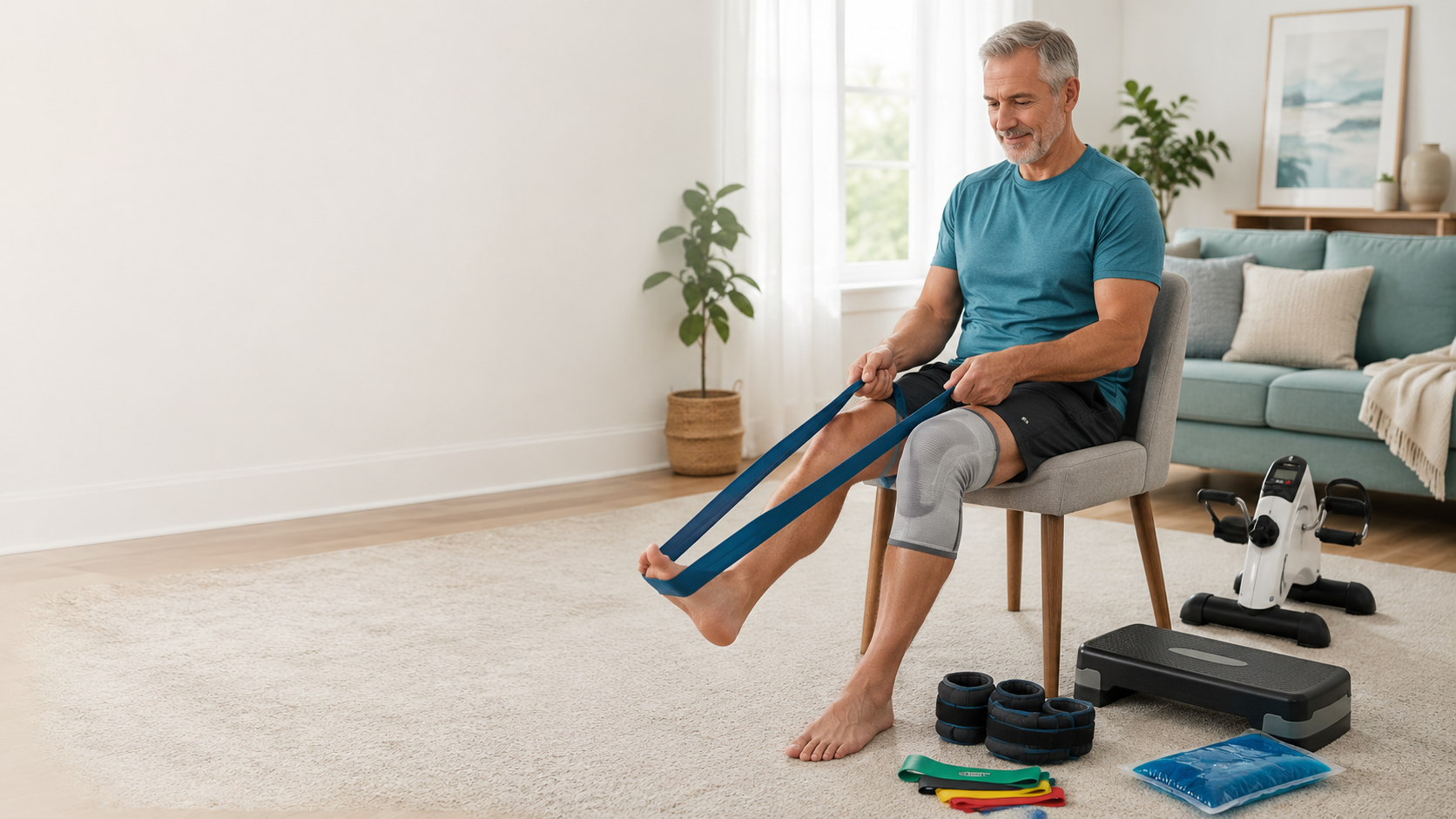
Helpful rehab equipment, organized by recovery need.
Browse curated rehab equipment that may help support your home exercises, mobility work, strengthening, comfort, and consistency.
These tools are optional. They are meant to support your rehab plan — not replace physical therapy, medical care, or instructions from your healthcare team.
How to use this page
Start with the body region or recovery goal that matches what you are working on.
- ✓ Use tools to support consistency, comfort, and exercise setup.
- ✓ Choose only what fits your goals, space, budget, and provider guidance.
- ✓ Use equipment as an add-on, not as a replacement for a good rehab plan.
Choose the toolkit that fits your needs.
Each list includes rehab equipment and recovery tools organized around a specific body region or recovery category.
Knee Replacement Recovery Tools
Tools that may support swelling management, knee motion, quad activation, strength, walking, and home exercise consistency after knee replacement.
Shoulder Rehab Tools
Equipment that may help with shoulder mobility, strengthening, positioning, and comfort during a shoulder rehab routine.
Foot and Ankle Rehab Tools
Tools that may support foot and ankle mobility, balance, arch support, calf work, and progressive strengthening.
Knee Pain Rehab Tools
Equipment that may help support knee strength, mobility, comfort, and exercise consistency for general knee pain rehab.
Neck Pain Rehab Tools
Tools that may support neck comfort, posture, mobility work, and gentle strengthening as part of a guided rehab routine.
Low Back Pain Rehab Tools
Equipment that may support low back mobility, core strengthening, symptom management, and home exercise setup.
You do not need every tool to make progress.
The most useful rehab equipment is the equipment that supports the plan you are actually following. Start simple, match the tool to your goal, and build from there.
Start with your goal
Are you trying to improve motion, build strength, manage swelling, support balance, or make exercise easier to complete?
Keep it practical
Choose tools that fit your space, budget, comfort level, and home routine. More equipment does not automatically mean better rehab.
Use it consistently
A simple tool used well and often is usually more valuable than a complicated setup that never becomes part of your routine.
Equipment should support your recovery plan. If a tool consistently worsens your symptoms or does not match your provider’s instructions, stop using it and follow the guidance from your healthcare team.
Pair the right tools with the right rehab plan.
Rehab equipment can help, but it works best when you know what you are trying to improve and how to progress. Browse Recovery Guides and Rehab Resources for more structure and education.
Tools support the plan.
The goal is not to buy more. The goal is to make the right exercises, habits, and progressions easier to follow.
Educational and affiliate disclaimer: Therapeutic Edge content and Rehab Toolkit recommendations are educational resources and do not create a provider-patient relationship. They are not a substitute for individualized medical advice, diagnosis, or treatment. As an Amazon Associate I earn from qualifying purchases. Product links may be paid affiliate links, and Therapeutic Edge may earn from qualifying purchases at no additional cost to you. Always follow the instructions provided by your surgeon, physical therapist, physician, or healthcare team.