

At its simplest, knee replacement surgery removes damaged joint surfaces in the knee and replaces them with artificial components designed to help the knee move more smoothly and with less pain.
This article explains what knee replacement surgery is, why it is done, how it generally works, and why recovery matters after the procedure.
Quick Answer
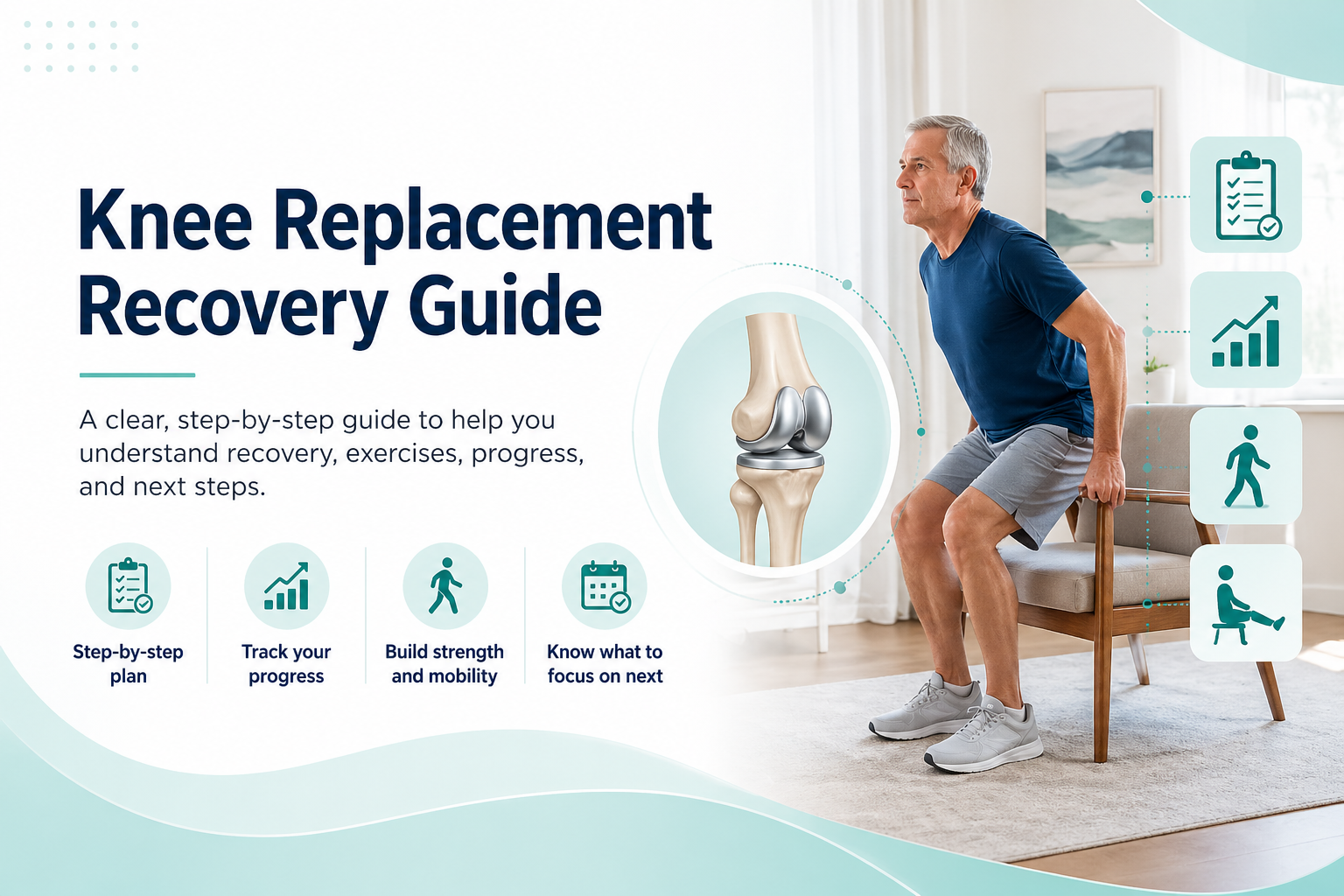
Knee replacement surgery, also called knee arthroplasty, is a procedure where damaged cartilage and bone in the knee are removed and replaced with metal and plastic components.
The goal is to reduce arthritis-related pain, improve function, and help the knee move more comfortably. But the surgery is only one part of the process. Recovery still requires swelling management, knee motion, walking, strength, and gradual return to activity.
Free Roadmap
Not sure where you are in knee replacement recovery?
Download the Total Knee Replacement Recovery Roadmap to see what usually matters most at each stage, how to think about swelling and stiffness, and when to progress, hold steady, or modify.
Key Takeaways
- Knee replacement replaces damaged knee joint surfaces with artificial components.
- It is most commonly done for advanced arthritis that causes pain, stiffness, and loss of function.
- The surgery can reduce pain and improve daily activity, but it does not instantly restore strength or motion.
- Recovery plays a major role in the final outcome.
- A good recovery plan should include swelling management, range of motion, quad activation, strengthening, walking, and gradual activity progression.
What Is Knee Replacement Surgery?
Knee replacement surgery is a procedure used to treat a knee joint that has become severely damaged, most often from arthritis.
During the procedure, the damaged surfaces of the knee joint are removed and replaced with artificial parts. These parts are usually made from metal and strong plastic materials designed to create a smoother surface for the knee to move on.
AAOS describes total knee replacement as a procedure where damaged cartilage and bone are removed and new metal and plastic implants are positioned to restore alignment and function. AAOS total knee replacement overview
The goal is not to create a brand-new biological knee. The goal is to reduce pain from the damaged joint surfaces and improve how well the knee functions during daily life.
Why Is Knee Replacement Surgery Done?
Knee replacement surgery is usually done when knee arthritis or joint damage has become severe enough that daily life is significantly limited.
People may consider surgery when knee pain, stiffness, or loss of function affects walking, stairs, standing, sleeping, working, exercise, or basic daily activities.
Common reasons people consider knee replacement include:
- Advanced osteoarthritis: The most common reason for knee replacement. Cartilage wears down over time, which can lead to pain, stiffness, swelling, and reduced joint space.
- Inflammatory arthritis: Conditions such as rheumatoid arthritis can damage the joint and contribute to pain, swelling, and loss of function.
- Post-traumatic arthritis: A previous fracture, ligament injury, or major knee trauma can lead to joint damage over time.
- Severe deformity or joint damage: Some knees become difficult to use because of alignment changes, stiffness, or advanced structural damage.
Johns Hopkins describes knee replacement as a procedure that may be considered for people with severe arthritis or severe knee injury. Johns Hopkins knee replacement procedure overview
How Does Knee Replacement Surgery Work?
The exact surgical plan depends on the person, the surgeon, the implant, and the type of knee problem being treated. But the general concept is similar.
During a total knee replacement, the surgeon typically:
- Removes damaged joint surfaces: Worn cartilage and a small amount of underlying bone are removed from the damaged areas of the knee.
- Positions the implant components: Metal components are placed to recreate the surfaces of the thighbone and shinbone.
- Adds a plastic spacer: A durable plastic insert helps create a smooth gliding surface between the metal components.
- Addresses the kneecap when needed: In some cases, the underside of the kneecap may also be resurfaced.
- Checks alignment and motion: The surgeon checks the knee’s movement, stability, and alignment before closing the incision.
The purpose of the artificial components is to help the knee move with less pain and better function than it could with the damaged joint surfaces.
Total Knee Replacement vs. Partial Knee Replacement
Not every knee replacement is the same.
A total knee replacement replaces the main damaged surfaces of the knee joint. This is the more common type when arthritis affects multiple areas of the knee.
A partial knee replacement replaces only one part of the knee. This may be an option for some people when arthritis is limited to one compartment of the knee and the rest of the joint is in better condition.
The right procedure depends on the pattern of arthritis, the condition of the knee, your goals, and your surgeon’s evaluation.
What Are the Expected Benefits?
For the right candidate, knee replacement can meaningfully improve pain, mobility, and quality of life.
Possible benefits include:
- Less arthritis-related knee pain.
- Improved walking tolerance.
- Better ability to use stairs.
- Improved ability to stand, shop, travel, or do daily tasks.
- Better quality of life when pain has been severely limiting.
That said, knee replacement is not magic. It can improve the joint, but the muscles, swelling response, walking pattern, balance, confidence, and activity tolerance still need to recover.
What Knee Replacement Does Not Automatically Fix
One of the biggest misconceptions is that surgery immediately restores everything.
The joint surfaces are replaced during surgery, but your body still needs time to recover from the operation.
Knee replacement does not automatically restore:
- Full quadriceps strength.
- Normal knee bending and straightening.
- Stair confidence.
- Balance and single-leg control.
- Endurance for long days.
- Confidence with exercise or recreational activity.
Those pieces are built during recovery. That is why the months after surgery matter.
What Is Recovery Like?
Recovery after knee replacement is a process, not a single milestone.
Early recovery often focuses on swelling management, pain control, gentle motion, quad activation, and safe walking. As recovery progresses, the focus shifts toward strength, stairs, endurance, balance, and return to daily activity.
Many people make meaningful progress during the first 6 to 12 weeks, but strength, endurance, swelling response, and confidence can continue improving for 6 to 12 months.
Common recovery priorities include:
- Managing swelling and stiffness.
- Restoring knee bending and straightening.
- Rebuilding quad activation and strength.
- Improving walking quality.
- Progressing stairs and daily activity.
- Building long-term strength and confidence.
Your Role in Recovery
The surgeon replaces the damaged joint surfaces. But your recovery depends on what happens after surgery too.
Your role is to gradually rebuild the knee’s ability to move, tolerate load, and handle daily life again.
Your recovery role includes:
- Practicing safe walking and movement.
- Working on knee motion without constantly forcing it.
- Managing swelling and workload.
- Rebuilding quad strength.
- Progressing exercises at the right pace.
- Learning when to push, hold steady, or adjust.
This is why knee replacement recovery should not be thought of as “surgery fixes everything.” A better way to think about it is: surgery changes the joint, and recovery rebuilds the function.
Common Mistakes
- Assuming surgery instantly restores strength and motion.
- Thinking walking alone is enough for full recovery.
- Ignoring swelling, stiffness, or limping after activity.
- Comparing your timeline to someone else’s recovery.
- Expecting the knee to feel completely normal right away.
- Stopping strength work once basic walking improves.
Related Learning
If you are learning about knee replacement or preparing for recovery, these articles may help:
FAQ
What is knee replacement surgery?
Knee replacement surgery is a procedure where damaged cartilage and bone in the knee are removed and replaced with artificial components, usually made of metal and plastic, to help the knee move with less pain.
Why is knee replacement surgery done?
Knee replacement is usually done for advanced arthritis or severe joint damage that causes pain, stiffness, and major limits with walking, stairs, standing, sleep, work, or daily activity.
What parts are replaced in a total knee replacement?
In a total knee replacement, the damaged surfaces of the thighbone and shinbone are replaced with artificial components. In some cases, the underside of the kneecap may also be resurfaced.
Is knee replacement a cure for arthritis?
Knee replacement can reduce pain from a damaged arthritic joint, but it does not instantly restore strength, motion, balance, or endurance. Those still need to be rebuilt during recovery.
How long does recovery take after knee replacement?
Many people make meaningful progress in the first 6 to 12 weeks, but strength, endurance, swelling response, and confidence can continue improving for 6 to 12 months.
What should I focus on after knee replacement?
Recovery usually includes swelling management, knee bending, knee straightening, quad activation, walking, strengthening, stairs, balance, and gradual return to activity.