

The idea of surgery can feel overwhelming, but understanding the basic steps can make the process feel less mysterious and help you set more realistic expectations for recovery.
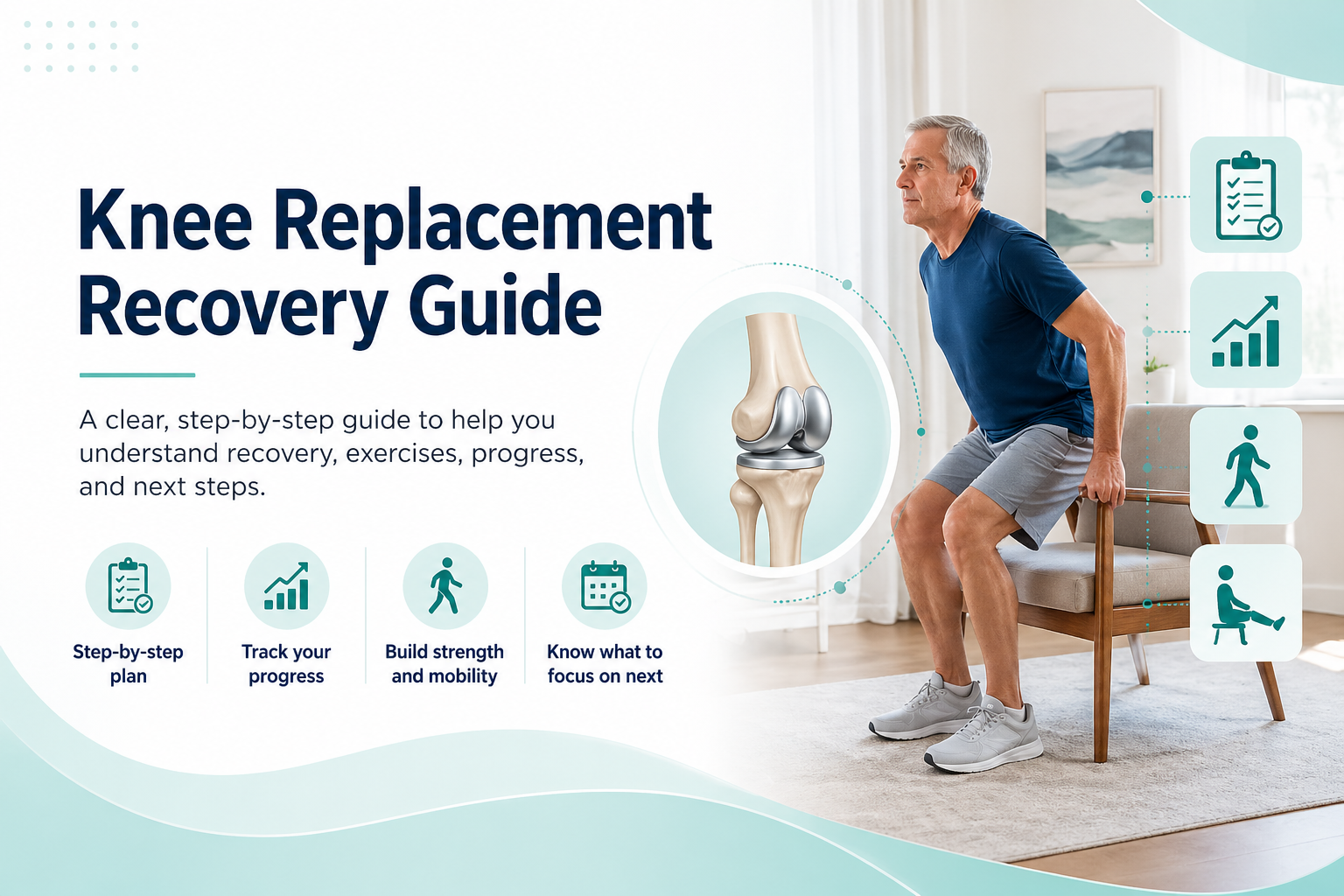
This article walks through the main steps of knee replacement surgery, what happens after the procedure, and why recovery is just as important as the operation itself.
Quick Answer
During a total knee replacement, the surgeon makes an incision, removes damaged cartilage and bone from the knee joint, shapes the bone surfaces, places metal and plastic implant components, checks knee alignment and movement, and closes the incision.
The surgery changes the damaged joint surfaces, but recovery still rebuilds function. After surgery, you still need swelling management, knee motion, quad activation, walking, strengthening, and gradual return to activity.
Free Roadmap
Not sure where you are in knee replacement recovery?
Download the Total Knee Replacement Recovery Roadmap to see what usually matters most at each stage, how to think about swelling and stiffness, and when to progress, hold steady, or modify.
Key Takeaways
- Knee replacement surgery resurfaces the damaged parts of the knee joint.
- The main implant parts usually include metal components and a plastic spacer.
- The kneecap may or may not be resurfaced depending on the knee and surgeon preference.
- Implants may be fixed with bone cement, cementless fixation, or a hybrid approach.
- The surgery is only the first step; recovery determines how well you rebuild strength, motion, walking, and confidence.
What Is the Goal of Knee Replacement Surgery?
The main goal of knee replacement surgery is to reduce pain from a damaged arthritic joint and improve function.
During the surgery, the damaged joint surfaces are removed and replaced with artificial components designed to help the knee move more smoothly.
AAOS describes total knee replacement as a procedure where damaged cartilage and bone are removed and new metal and plastic implants are positioned to restore knee alignment and function. AAOS total knee replacement overview
A helpful way to think about it is this: surgery changes the joint surfaces, but recovery rebuilds the function.
Step 1: The Surgeon Makes the Incision
The procedure usually begins with an incision over the front of the knee. The size and exact location of the incision depend on your anatomy, the surgical approach, implant type, and surgeon preference.
This incision gives the surgeon access to the knee joint so the damaged surfaces can be prepared and replaced.
Some people hear about “minimally invasive” knee replacement techniques. A smaller incision may be possible in some cases, but the most important goal is not simply a smaller scar. The bigger goal is safe implant positioning, proper alignment, and a knee that functions well after surgery.
Step 2: Damaged Joint Surfaces Are Removed
Arthritis damages the smooth cartilage and underlying joint surfaces of the knee. During surgery, the surgeon removes the damaged cartilage and a small amount of bone from the involved areas.
The ends of the thighbone and shinbone are shaped so the implant components can fit properly.
This step matters because it helps determine:
- How the implant fits.
- How the knee lines up.
- How the knee bends and straightens.
- How stable the knee feels after surgery.
- How forces move through the leg during walking and activity.
Step 3: The Implant Components Are Positioned
Once the damaged surfaces are prepared, the artificial components are placed.
A total knee replacement commonly includes a femoral component, a tibial component, and a plastic spacer. In some cases, the underside of the kneecap may also be resurfaced.
The main components include:
- Femoral component: A metal component that covers the prepared end of the thighbone.
- Tibial component: A metal tray or base that sits on the prepared top of the shinbone.
- Plastic spacer: A medical-grade polyethylene insert that sits between the metal parts and acts like artificial cartilage.
- Patellar component: A plastic component that may be used on the underside of the kneecap if the surgeon resurfaces it.
The purpose of these parts is to create a smoother, more functional surface for the knee to move on.
Step 4: The Components Are Fixed to Bone
The implant components need to be securely attached to the bone.
There are different fixation methods, and the best choice depends on factors like bone quality, implant design, surgeon preference, age, anatomy, and activity goals.
Common fixation methods include:
- Cemented fixation: Bone cement is used to secure the implant components to the bone.
- Cementless fixation: Also called press-fit fixation, where the implant is designed so bone can grow into or onto it over time.
- Hybrid fixation: A combination of cemented and cementless techniques.
None of these options is automatically best for everyone. Your surgeon chooses the method based on your specific knee and surgical plan.
Step 5: The Kneecap May Be Resurfaced
In some total knee replacements, the underside of the kneecap is resurfaced with a plastic component.
In other cases, the surgeon may decide not to resurface the kneecap. This depends on the condition of the patella, implant design, surgeon preference, and how the knee tracks during surgery.
The important point is that kneecap resurfacing is not the same for every person. It is part of the surgical decision-making process.
Step 6: The Surgeon Checks Motion, Alignment, and Stability
Before closing the incision, the surgeon checks how the knee moves and how the components are functioning.
The surgeon may assess:
- Knee bending and straightening.
- Implant position.
- Soft tissue balance.
- Joint stability.
- Kneecap tracking.
- Overall leg alignment.
This step helps confirm that the knee is moving and functioning appropriately before the surgical wound is closed.
Step 7: The Incision Is Closed
Once the components are in place and the knee has been checked, the incision is closed.
Different closure methods may be used, including sutures, staples, adhesives, or layered closure techniques depending on the surgeon’s preference and the specific situation.
A dressing is then applied to protect the incision as the early healing process begins.
What Happens Right After Surgery?
After surgery, the early focus is safety, pain control, swelling management, movement, and beginning the recovery process.
Many people begin walking with assistance early after surgery, often with a walker or other assistive device. The exact timeline depends on the surgical plan, hospital or surgery center protocol, symptoms, medical status, and your surgeon’s instructions.
Early recovery usually focuses on:
- Managing pain and swelling.
- Protecting the incision.
- Beginning gentle knee motion.
- Activating the quadriceps.
- Walking safely with support.
- Preventing complications such as blood clots.
The first few days and weeks are not about doing everything perfectly. They are about getting moving safely, managing symptoms, and starting to rebuild function.
What Are the Main Risks?
Knee replacement is a common and generally successful procedure, but it is still major surgery and has risks.
AAHKS notes that complications are relatively rare but may include serious issues such as blood clots, infection, stiffness, loss of motion, and implant problems over time. AAHKS total knee replacement overview
Possible risks include:
- Infection.
- Blood clots.
- Stiffness or limited motion.
- Persistent pain or swelling.
- Implant loosening or wear over time.
- Nerve, blood vessel, or wound-healing issues.
- Medical complications related to surgery or anesthesia.
This does not mean you should expect complications. It means you should understand the risks, follow your surgeon’s instructions, and know what warning signs to take seriously.
How to Prepare for a Better Recovery
You cannot control every part of surgery or recovery, but preparation can help.
Helpful preparation may include:
- Building strength before surgery: Stronger muscles can help you start recovery from a better place.
- Preparing your home: Clear walkways, arrange essentials, and reduce fall hazards.
- Understanding the recovery timeline: Swelling, stiffness, soreness, and quad weakness are common early on.
- Planning support: Transportation, meals, errands, and household help may be needed early after surgery.
- Clarifying instructions: Ask about medications, wound care, activity limits, and follow-up visits.
- Setting realistic expectations: The knee usually improves over time, not overnight.
Why Recovery Matters So Much
The surgical procedure creates the opportunity for better movement and less arthritis-related pain. But the recovery process determines how well you rebuild the pieces that surgery does not automatically restore.
Recovery still needs:
- Swelling management.
- Knee bending and straightening.
- Quad activation.
- Walking practice.
- Strength training.
- Stair progression.
- Balance and confidence.
- Gradual return to daily activity and exercise.
The implant changes the joint. Rehab rebuilds your ability to use it.
Common Mistakes
- Thinking the surgery is the whole recovery.
- Assuming a smaller incision automatically means a better outcome.
- Expecting strength and motion to return immediately.
- Ignoring swelling, stiffness, or limping after activity.
- Not preparing your home before surgery.
- Not asking what the first few weeks after surgery should look like.
Related Learning
If you are learning about knee replacement surgery or preparing for recovery, these articles may help:
FAQ
What happens during knee replacement surgery?
During knee replacement surgery, damaged cartilage and bone are removed from the knee joint, the bone surfaces are shaped, metal and plastic components are placed, the knee is checked for motion and stability, and the incision is closed.
How long does knee replacement surgery take?
The exact time varies based on the surgical plan, the knee, and the surgeon. Your surgical team can give you the most accurate estimate for your specific procedure.
Does the kneecap get replaced during knee replacement?
Sometimes. In some cases, the underside of the kneecap is resurfaced with a plastic component. In other cases, the surgeon may choose not to resurface it.
Are knee replacement implants cemented in place?
Some knee replacements use bone cement, while others use cementless or press-fit fixation. Some use a hybrid approach. The best fixation method depends on your bone quality, implant type, and surgeon’s plan.
What should I expect right after surgery?
Early recovery usually focuses on pain control, swelling management, gentle motion, quad activation, incision protection, and safe walking with assistance.
Why does rehab matter if the joint was replaced?
The surgery replaces damaged joint surfaces, but it does not instantly restore strength, motion, balance, walking quality, or confidence. Rehab rebuilds those pieces over time.