This is especially common in the quadriceps, the large muscle group on the front of the thigh. The quad plays a major role in walking, standing, stairs, balance, and knee control.
Neuromuscular electrical stimulation, often called NMES, may help some people improve quad activation after knee replacement. It is not magic, and it does not replace exercise. But when used well, it can be a useful tool alongside a structured recovery plan.
Quick Answer
NMES is a type of electrical stimulation used to help muscles contract. After knee replacement, it is commonly used on the quadriceps to help improve muscle activation and reduce early strength loss.
NMES is different from TENS. TENS is usually used for pain relief. NMES is used to create a muscle contraction. For knee replacement recovery, NMES is most useful when paired with active quad exercises, walking practice, and progressive strengthening.
Free Roadmap
Not sure where you are in knee replacement recovery?
Download the Total Knee Replacement Recovery Roadmap to see what usually matters most at each stage, how to think about swelling and stiffness, and when to progress, hold steady, or modify.
Key Takeaways
- Quad weakness is common after total knee replacement.
- Swelling, pain, joint irritation, and surgery can make it harder for the quad to fully activate.
- NMES can help create a stronger quad contraction when the muscle feels difficult to turn on.
- NMES works best as a supplement to exercise, not as a replacement for exercise.
- The goal is better quad activation, better walking, better stair control, and better long-term strength.
Why Quad Strength Matters After Knee Replacement
Your quadriceps help control the knee during daily activity. They help you straighten the knee, stand up from a chair, walk without buckling, climb stairs, and lower yourself with control.
After knee replacement, quad strength is often limited. This can make the knee feel heavy, weak, unreliable, or difficult to control.
Quad weakness can affect:
- Walking quality.
- Ability to straighten the knee.
- Stair climbing.
- Getting out of chairs.
- Balance and confidence.
- Exercise progression.
- Long-term function.
This is why quad activation is one of the most important early recovery priorities after total knee replacement.
Why Does the Quad Feel Shut Down?
Quad weakness after knee replacement is not always just simple muscle loss. Sometimes the muscle is present, but your nervous system is not allowing it to contract well.
This is often related to a process called arthrogenic muscle inhibition. In plain language, the knee joint is irritated, swollen, painful, or recovering from surgery, and that joint irritation can reduce the brain and nervous system’s ability to fully activate the quad.
Common contributors include:
- Swelling inside and around the knee.
- Pain or guarding.
- Joint inflammation.
- Reduced activity before surgery.
- Surgical trauma.
- Fear or hesitation with movement.
- Difficulty trusting the knee early in recovery.
This is why some people can try hard to squeeze the quad, but the contraction still feels weak, delayed, or incomplete.
What Is NMES?
NMES stands for neuromuscular electrical stimulation.
It uses electrical impulses through pads placed on the skin to stimulate a muscle contraction. When used after knee replacement, NMES is commonly applied to the quadriceps to help the muscle contract more strongly.
The goal is not just to “feel tingling.” The goal is usually to create a visible and meaningful muscle contraction.
The physical therapy clinical practice guideline for total knee arthroplasty recommends that physical therapists use NMES after TKA to improve quadriceps strength, gait performance, performance-based outcomes, and patient-reported outcomes. Physical Therapist Management of Total Knee Arthroplasty Clinical Practice Guideline
NMES vs. TENS: What Is the Difference?
NMES and TENS are often confused, but they are not the same thing.
TENS:
- Usually focuses on pain relief.
- Often feels like tingling or buzzing.
- Does not necessarily create a strong muscle contraction.
NMES:
- Focuses on muscle activation.
- Is used to create a muscle contraction.
- May help the quad “wake up” when it is difficult to activate voluntarily.
If your goal is quad activation after knee replacement, the device and settings matter. A general pain-relief TENS unit is not always the same as an NMES setup designed to produce strong quadriceps contractions.
How NMES May Help After Knee Replacement
NMES may help by giving the quad a stronger activation signal during a time when the knee is swollen, painful, or inhibited.
NMES may help by:
- Improving quad activation.
- Helping create a stronger muscle contraction.
- Reducing early strength loss.
- Supporting better knee control during recovery.
- Helping the person feel what a stronger quad contraction should feel like.
- Making early strengthening more effective when voluntary activation is limited.
A 2021 systematic review and meta-analysis found that postoperative NMES may improve quadriceps strength after total knee arthroplasty, although the authors also noted that some outcomes did not clearly reach meaningful clinical differences and that the size of the real-world benefit can vary. Systematic review and meta-analysis on NMES after TKA
That is the right way to think about NMES: useful for some people, supported enough to consider, but not a magic shortcut.
When NMES May Be Most Helpful
NMES is often most useful when the quad is clearly struggling to activate.
It may be worth discussing if:
- You have difficulty getting a strong quad contraction.
- Your knee feels like it wants to buckle.
- You have trouble performing a straight leg raise.
- Your walking pattern is limited by quad weakness.
- Your knee remains very swollen and the quad feels inhibited.
- You are working hard during rehab but the quad still feels delayed or shut down.
NMES may be especially useful early in recovery, when quad activation deficits can be most limiting.
How NMES Is Usually Used
NMES is usually applied through adhesive pads placed over the quadriceps. The device sends electrical impulses that cause the muscle to contract and relax.
The exact setup should be guided by your rehab professional, surgical team, or device instructions.
A typical NMES session may include:
- Electrode pads placed over the quadriceps.
- A contraction phase where the quad tightens.
- A rest phase where the muscle relaxes.
- Several repeated contractions during the session.
- Exercises such as quad sets or straight leg raises paired with stimulation when appropriate.
The stimulation should usually be strong enough to create a meaningful contraction, but it should not create sharp knee pain or make the knee feel more irritated afterward.
NMES Works Best With Exercise
NMES should not be treated as a passive replacement for rehab.
The better approach is to use NMES to improve the quality of muscle activation, then reinforce that activation with movement and strengthening.
NMES may pair well with:
- Quad sets.
- Straight leg raises when appropriate.
- Short arc quads when tolerated.
- Terminal knee extension work.
- Sit-to-stands.
- Step-ups later in recovery.
- Walking practice with better knee control.
The goal is for the quad to carry over into real function, not just contract during the device session.
How Strong Should the Contraction Be?
For NMES to help with strengthening or activation, the contraction usually needs to be strong enough to matter.
A light tingling sensation may feel interesting, but it may not be enough to meaningfully challenge the quadriceps.
A useful contraction usually looks like:
- A visible quad tightening.
- The kneecap pulling upward slightly.
- A firm contraction you can feel under your hand.
- A contraction that is tolerable but not barely noticeable.
That said, stronger is not always better if the knee becomes more painful, guarded, or irritated. The goal is a strong, tolerable contraction that supports recovery.
When NMES May Not Be the Right Tool
NMES is not appropriate for every person or every situation.
You should follow your surgical team’s, physical therapist’s, and device manufacturer’s instructions. NMES may not be appropriate for some people with certain implanted devices, skin irritation, open wounds near the electrode area, poor sensation, or other medical considerations.
It also may not be the right tool if it increases pain, causes skin irritation, or makes the knee more reactive afterward.
Common Mistakes
- Using a TENS-style pain setting and expecting it to rebuild quad strength.
- Keeping the intensity so low that the quad barely contracts.
- Using NMES passively without pairing it with exercise.
- Ignoring swelling and workload while trying to force quad activation.
- Stopping strengthening because NMES is being used.
- Assuming NMES is required for every knee replacement recovery.
- Using NMES when the skin is irritated or the device setup does not feel right.
How to Know If NMES Is Helping
NMES should make quad activation and function easier over time.
Signs it may be helping include:
- You can create a stronger quad contraction.
- The quad feels easier to “find” during exercises.
- Straightening the knee becomes easier.
- Walking feels more controlled.
- Your knee feels less likely to buckle.
- You can progress strengthening with better control.
If you are using NMES consistently but the quad still feels completely shut down, or if the knee is becoming more swollen or painful, the plan may need to be adjusted.
Where NMES Fits in the Bigger Recovery Plan
NMES is one tool. It should fit into a larger recovery plan that includes swelling management, knee motion, walking, strengthening, balance, and gradual return to activity.
A complete quad recovery plan usually includes:
- Managing swelling so the quad can activate better.
- Practicing quad sets and active knee straightening.
- Improving knee extension.
- Walking with good mechanics.
- Using NMES when activation is limited.
- Progressing strength over time.
- Building confidence with stairs and daily activity.
NMES can help open the door, but exercise and progressive loading are what keep building the strength.
Related Learning
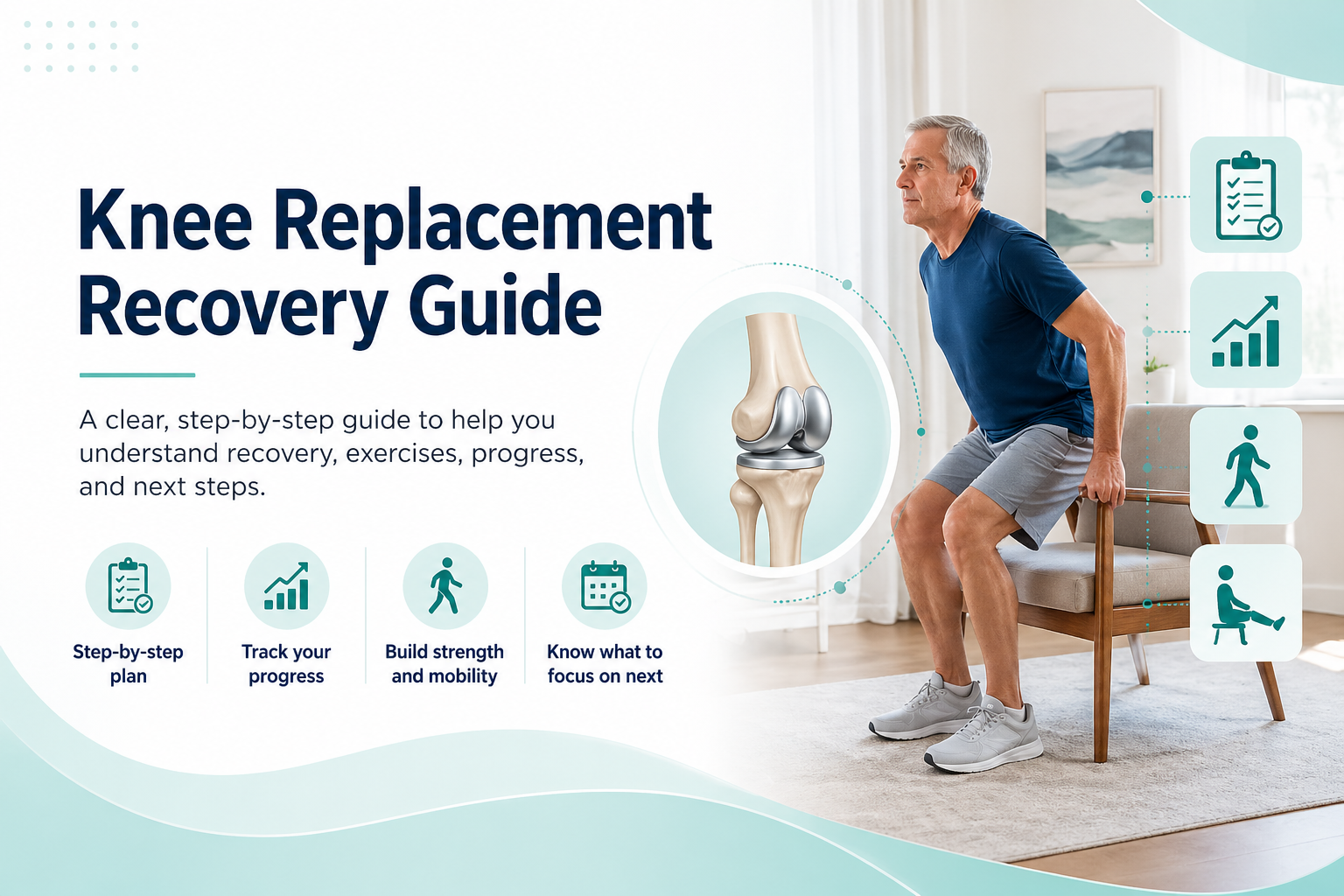
If you are working on quad strength and muscle activation after knee replacement, these articles may help:
FAQ
What is NMES after knee replacement?
NMES stands for neuromuscular electrical stimulation. It uses electrical impulses through skin pads to help the quadriceps contract after knee replacement.
Is NMES the same as TENS?
No. TENS is usually used for pain relief, while NMES is used to create a muscle contraction. For quad weakness after knee replacement, NMES is the more relevant tool.
Can NMES help quad weakness after knee replacement?
NMES may help some people improve quad activation and strength after knee replacement, especially when the quad feels difficult to contract early in recovery. It works best when combined with exercise.
When should NMES be used after knee replacement?
NMES is often most useful early in recovery when quad activation is limited. The exact timing and setup should follow your rehab professional’s, surgical team’s, or device instructions.
Does NMES replace quad exercises?
No. NMES should support quad exercises, not replace them. The goal is to improve activation so strengthening, walking, and functional training become more effective.
How do I know if NMES is working?
NMES may be helping if your quad contraction feels stronger, the muscle is easier to activate, walking feels more controlled, and you can progress strengthening with better knee control.