

After total knee replacement, it is common for the front of the knee to feel stiff, tight, swollen, or uncomfortable.
Sometimes that stiffness feels like it is coming from the knee joint itself. Other times, it may feel like the kneecap does not want to move normally. This can make bending, straightening, walking, stairs, and exercise feel more restricted than they should.
A simple kneecap mobility routine can sometimes help the knee feel more comfortable before movement.
This routine is short, gentle, and designed to help you practice small kneecap glides without forcing the knee or irritating the incision.
Quick Answer
Kneecap mobility after total knee replacement can help reduce front-of-knee stiffness and improve comfort before exercise.
The routine is simple: gently glide the kneecap side to side for 30–60 seconds, then gently glide it up and down for 30–60 seconds.
Keep the pressure light, keep the leg relaxed, and avoid pressing directly over the incision until it is fully healed and cleared by your medical team.
Roadmap PDF
Want the recovery timeline in one place?
Download the Total Knee Replacement Recovery Roadmap to see what usually matters most at each stage and when to progress, hold steady, or modify.
Watch: 1-Minute Kneecap Mobility After Total Knee Replacement
This video walks you through the same kneecap mobility routine shown in the infographic below. Use gentle pressure, keep the movement small, and avoid direct pressure over the incision until it is fully healed.
Key Takeaways
- Kneecap mobility may help the front of the knee feel less stiff before exercise.
- The movement should be small, gentle, and comfortable.
- Start with side-to-side kneecap glides for 30–60 seconds.
- Then perform up-and-down kneecap glides for 30–60 seconds.
- Keep the leg relaxed so the kneecap can move more easily.
- Avoid direct pressure over the incision until it is fully healed.
Why the Kneecap Can Feel Stiff After Total Knee Replacement
After a total knee replacement, the knee has to recover from surgery, swelling, soreness, stiffness, and changes in how the leg moves.
The kneecap sits on the front of the knee and normally needs to glide slightly as the knee bends and straightens. When the knee is swollen, guarded, or sensitive, that small kneecap movement can feel restricted.
This may contribute to a feeling of tightness across the front of the knee, especially before exercise, walking, or knee bending work.
Gentle kneecap mobility can help by giving the front of the knee a calm, controlled movement input before you ask the knee to do more.
The goal is not to force the kneecap loose. The goal is to gently remind the area that small movement is safe and tolerable.
Before You Start: Protect the Incision
Important Incision Rule
Do not press directly on or massage over your knee replacement incision until it is fully healed.
That means no open areas, drainage, scabs, staples, stitches, or irritated skin. If you are not sure whether the incision is ready, ask your surgeon, physical therapist, or medical team first.
This routine should be done around the kneecap with gentle pressure. If your incision is still healing or sits in the area where your fingers would press, wait until you are cleared before trying this technique.
Once the incision is fully healed, your physical therapist may give you more specific guidance on kneecap mobility, scar mobility, or soft tissue work based on your recovery.
How to Use the Infographic
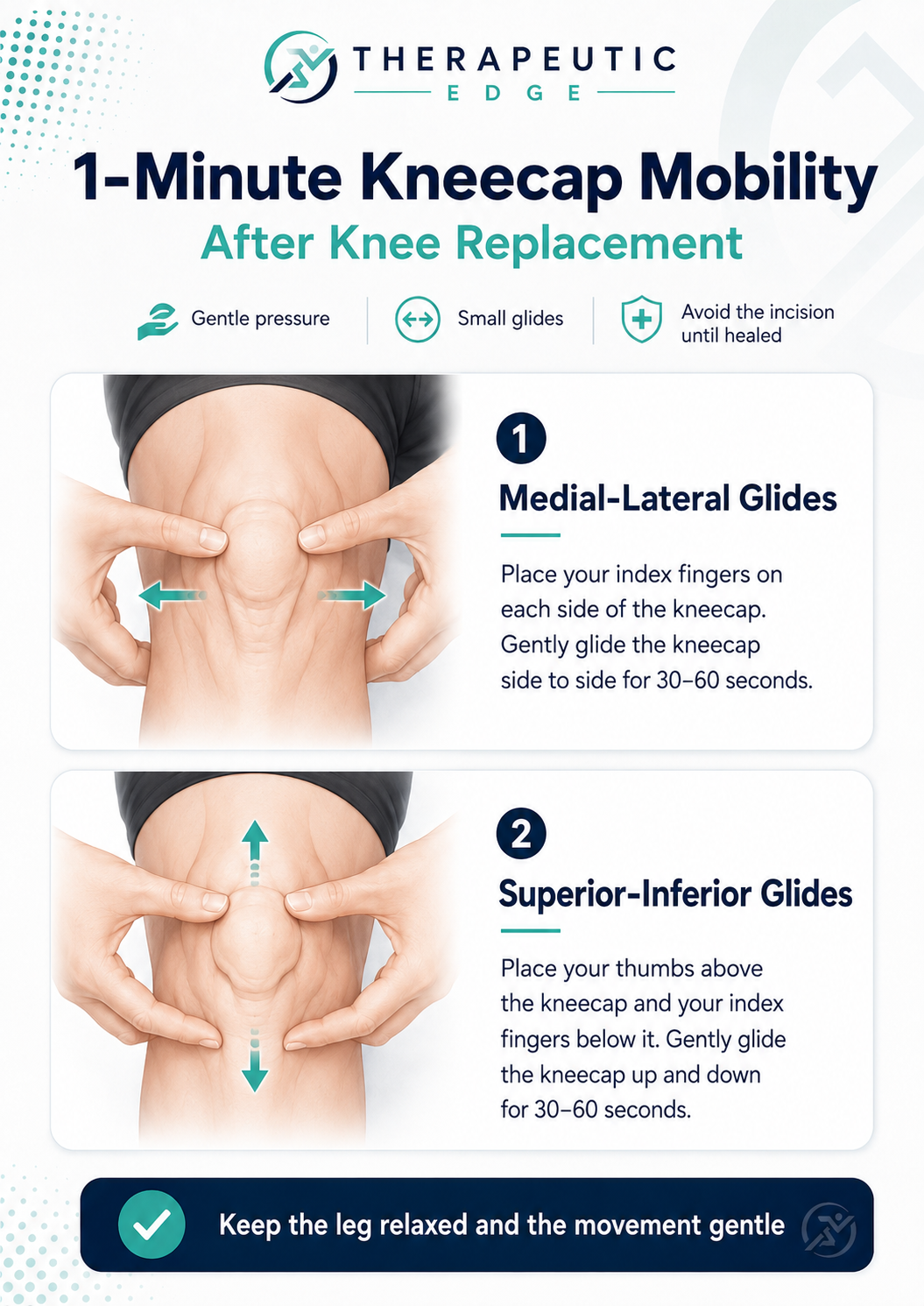
The infographic below gives you a quick visual guide for this 1-minute kneecap mobility routine after total knee replacement.
The routine has two parts:
- Medial-lateral glides: gently moving the kneecap side to side.
- Superior-inferior glides: gently moving the kneecap up and down.
The Simple 1-Minute Kneecap Mobility Routine
Find a comfortable position where your leg can relax. This may be lying down or sitting with the leg supported.
The key is to let the thigh muscles relax. If the quad is tense, the kneecap may feel harder to move.
The Routine
- Side-to-side glides: Place your index fingers on each side of the kneecap and gently glide the kneecap left and right for 30–60 seconds.
- Up-and-down glides: Place your thumbs above the kneecap and your index fingers below it, then gently glide the kneecap up and down for 30–60 seconds.
The movement should be small. You are not trying to push hard or create a big stretch. You are simply guiding the kneecap through a gentle glide.
Step 1: Side-to-Side Kneecap Glides
Side-to-side kneecap glides are also called medial-lateral patellar glides.
To perform them, place your index fingers on each side of the kneecap. Then gently glide the kneecap side to side.
How to do side-to-side glides
- Relax your leg as much as possible.
- Place your index fingers on the inside and outside edges of the kneecap.
- Gently glide the kneecap toward one side, then the other.
- Use small, comfortable movements.
- Continue for 30–60 seconds.
This should feel like a gentle glide, not an aggressive push. If the knee tightens up, lighten the pressure and slow the movement down.
Step 2: Up-and-Down Kneecap Glides
Up-and-down kneecap glides are also called superior-inferior patellar glides.
For this movement, place your thumbs above the kneecap and your index fingers below it. Then gently glide the kneecap up and down.
How to do up-and-down glides
- Keep the leg supported and relaxed.
- Place your thumbs on the top edge of the kneecap.
- Place your index fingers on the bottom edge of the kneecap.
- Gently glide the kneecap upward and downward.
- Continue for 30–60 seconds.
Again, the goal is not to force range. The goal is to create a small, comfortable movement that helps the front of the knee feel less stiff.
How Hard Should You Push?
Start with very light pressure.
A good kneecap mobility routine after total knee replacement should feel gentle, controlled, and tolerable. It should not feel sharp, intense, or irritating.
Use this simple pressure guide:
- Good: light pressure, small movement, mild stiffness, or improved comfort afterward.
- Too much: sharp pain, pinching, increased guarding, throbbing, or worse soreness afterward.
- Best rule: your knee should feel the same or better when you finish, not more irritated.
If the kneecap does not move much, do not force it. Swelling, guarding, and healing can all limit how much motion you feel at first.
When Should You Use Kneecap Mobility?
This routine works best as a short preparation tool.
Good times to use kneecap mobility include:
- Before knee bending exercises.
- Before knee straightening exercises.
- Before quad activation work.
- Before a short walk.
- When the front of the knee feels stiff from sitting.
You do not need to spend a long time on it. One minute is usually enough to see whether it helps the knee feel more comfortable before movement.
What Kneecap Mobility Should Not Replace
Kneecap mobility can help the front of the knee feel less stiff, but it is not the whole recovery plan.
You still need the right amount of:
- Knee bending and straightening work.
- Quad activation.
- Walking practice.
- Strengthening.
- Swelling management.
- Progressive return to daily activity.
Think of kneecap mobility as a quick warm-up or comfort strategy. It may help prepare the knee to move, but the exercises and activity progression still matter most.
When To Be More Cautious
Most stiffness and soreness after total knee replacement are part of the recovery process, but some symptoms deserve more caution.
Do not perform kneecap mobility and contact your medical team if you notice:
- New or rapidly increasing calf swelling.
- Calf warmth, redness, or significant tenderness.
- Sudden shortness of breath or chest pain.
- Fever, chills, or feeling unusually ill.
- Increasing redness, drainage, opening, or worsening pain around the incision.
- New sharp pain around the kneecap that does not settle.
- Swelling or pain that keeps getting worse instead of gradually settling.
Also avoid this routine if the skin around the knee is irritated, open, infected, unusually sensitive, or not fully healed.
Related Learning
Want to keep learning about this part of knee replacement recovery? These articles may help:
- Self-Massage After Total Knee Replacement: A Simple 5-Minute Routine
- Why Is My Knee Still Swollen After Knee Replacement?
- Why Does My Quad Feel Shut Down After Knee Replacement?
- How to Improve Knee Extension After Knee Replacement
- How Do I Know If I’m Doing Too Much After Knee Replacement?
FAQ
What is kneecap mobility after total knee replacement?
Kneecap mobility is a gentle technique where you glide the kneecap slightly side to side and up and down. The goal is to reduce front-of-knee stiffness and help the knee feel more comfortable before exercise.
When can I start kneecap mobility after knee replacement?
Only start when your surgeon, physical therapist, or medical team says it is appropriate. You should avoid direct pressure over the incision until it is fully healed.
Should kneecap mobility hurt?
No. It may feel mildly stiff or restricted, but it should not feel sharp, painful, or aggressive. If your knee feels more irritated afterward, use less pressure or stop and ask your physical therapist for guidance.
How long should I do kneecap mobility?
A simple routine can take about 1 minute: 30–60 seconds of side-to-side glides and 30–60 seconds of up-and-down glides.
Why does my kneecap feel stiff after total knee replacement?
Swelling, soreness, guarding, healing tissues, and changes in how you move can all make the front of the knee feel stiff. Gentle kneecap mobility may help the area feel less restricted before exercise.
Can kneecap mobility improve knee bending?
It may help the knee feel more comfortable before bending exercises, but it should not replace your full rehab plan. Knee bending usually improves through a combination of swelling management, mobility work, quad activation, walking, and progressive strengthening.
Can I do kneecap mobility every day?
Many people can tolerate a short, gentle routine daily, but it depends on your healing, sensitivity, incision status, and your medical team’s guidance. The knee should feel the same or better afterward, not more irritated.
Looking for more knee replacement guidance? Browse Knee Replacement Resources.