

You may know that strengthening is important. You may want to keep your legs strong, make stairs easier, improve confidence, or stay active.
But then you try to squat, and your knee hurts.
Maybe it hurts during the movement. Maybe it feels okay in the moment but gets stiff later that day. Maybe it feels swollen, sore, or harder to trust the next morning.
That can make you think:
“Squats must be bad for my knee.”
But that is usually not the most useful conclusion.
A better question is:
“Which version of the squat can my knee tolerate and recover from right now?”
Because a squat is not just one exercise.
You can change the support, depth, body position, stance, ankle position, resistance, repetitions, speed, and recovery time.
The goal is not to avoid squatting forever. The goal is to find a version your knee can tolerate, repeat, recover from, and gradually progress.
Squats Hurt With Knee Arthritis? Change These 6 Things
This video walks through the same squat modification framework explained in this article.
Quick Answer
If squats hurt with knee arthritis, it does not automatically mean squats are damaging your knee or that you should stop forever. It usually means the current version of the squat may be more than your knee can tolerate and recover from right now.
Before quitting squats completely, try changing one variable at a time: support, depth, body position, stance, ankle position, or total dose. Then watch how your knee responds during the squat, later that day, and the next morning.
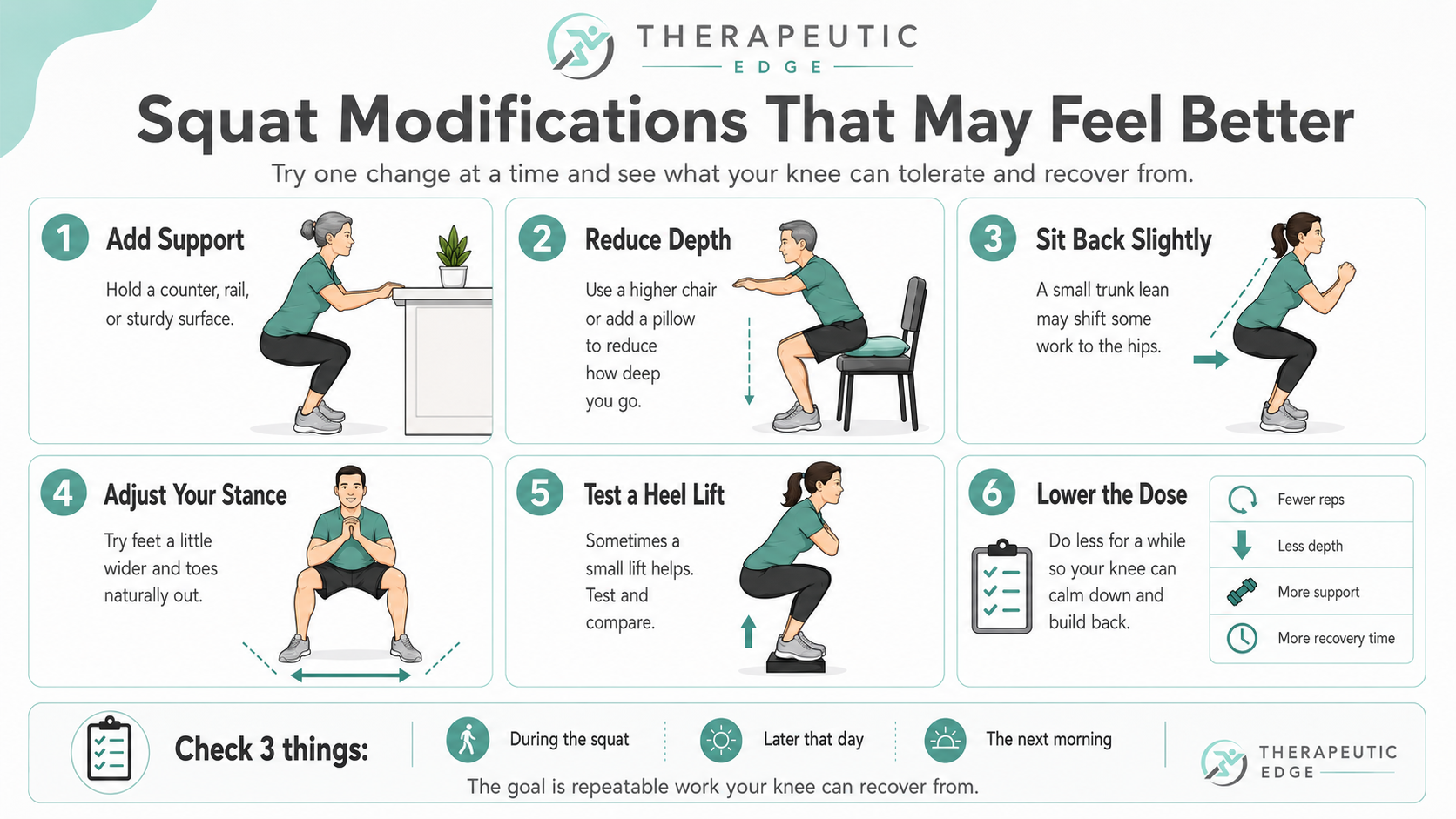
Six Squat Modifications to Test
Use this as a quick reference before you start changing everything at once. Pick one modification, test a few controlled repetitions, and compare how your knee responds during the squat, later that day, and the next morning.
Key Takeaways
- Squats are not automatically bad for knee arthritis, but the current version may be too much.
- Depth is one of the easiest ways to adjust squat difficulty.
- Using support is not cheating. It can help you train a more controlled and repeatable movement.
- Body position, stance, ankle position, and total dose can all change how the squat feels.
- Use the 24-hour response rule to decide whether to continue, modify, or reduce the squat dose.
Why Squats Can Hurt With Knee Arthritis
Squatting asks the knee to bend while the thigh muscles control your body weight.
That is not a bad thing. In fact, squatting is part of normal daily life. Every time you sit down, stand up from a chair, lower yourself toward a toilet, or pick something up from the floor, you are using some version of a squat.
But squats can become irritating when the version you choose is more than your knee is ready to handle.
A shallow squat to a high chair is very different from a deep weighted squat.
A supported squat is very different from an unsupported squat.
Six controlled repetitions are very different from twenty fast repetitions done when your knee is already irritated.
So when a squat hurts, the first question should not be:
“Are squats good or bad?”
The better question is:
“What version of the squat did my knee react to?”
That question gives you something useful to change.
First, Test Your Current Squat
Before changing anything, test your current squat with a small, controlled dose.
Try about five controlled repetitions. Squat toward a chair and hold a stable surface if needed.
Pay attention to:
- How much discomfort do you feel?
- Where do you feel it?
- Does the discomfort stay stable or increase with each repetition?
- Does your movement become less controlled?
- Do you shift away from one leg?
- How does the knee respond later that day and the next morning?
Then use a simple process:
- Change one variable.
- Repeat the squat.
- Compare the response.
- Keep the change if it helps.
- Discard it if it does not.
Use This Before You Change Everything
Do five controlled repetitions. Then change one variable and repeat.
The goal is not to find the hardest squat you can survive. The goal is to find repeatable work your knee can recover from.
Change 1: Add Support
Start by holding a countertop, railing, suspension strap, or another stable surface.
Support can do two different things.
A light touch may improve your balance and confidence without dramatically changing how much work your legs perform.
Actively using your arms can provide more assistance and reduce how much body weight your knee has to manage.
Neither option is cheating.
Support can help you make the movement smoother, more controlled, and more repeatable. That matters, especially if your knee is painful, swollen, or guarded.
As your knee becomes stronger and more tolerant, you can gradually reduce how much help you use.
Try this: Hold a counter or railing and perform five slow, comfortable squats to a chair. If symptoms decrease or the movement feels more controlled, support may be a useful starting modification.
Change 2: Reduce the Depth
Depth is one of the most useful ways to change the difficulty of a squat.
As the knee bends farther, the squat usually becomes a larger dose for the knee and quadriceps.
That does not mean deeper squats are damaging.
It means deeper squats may be more than your knee is ready for right now.
Try squatting toward a higher chair, box, or bench. Find the deepest position you can control without producing an unacceptable response.
You may begin with a very shallow squat.
That is a starting point, not a failure.
Once that depth becomes predictable, you can gradually lower the target.
Depth should be earned through progression, not forced during one session.
Change 3: Adjust Your Trunk and Shin Position
Your body position changes how the work is distributed.
Staying more upright and allowing the knees to move farther forward usually places more demand on the knee and quadriceps.
Sitting the hips slightly farther back and allowing a modest forward trunk lean can shift more demand toward the hips and trunk.
Neither strategy is universally right or wrong.
They simply distribute the work differently.
If the front of your knee is sensitive, try sitting the hips back slightly more while keeping your whole foot in contact with the floor.
But do not force your shins to stay perfectly vertical.
You should not need to lift your toes, lose your balance, or fold excessively through your back just to keep your knees behind your toes.
Your knees moving forward over your toes is not automatically dangerous. It is simply a more demanding position for the knee.
Reducing that demand may help now. Gradually rebuilding it may help you tolerate stairs, lower chairs, and deeper squatting later.
Knees Over Toes Is Not Automatically Bad
Forward knee movement usually increases knee demand. That may be useful later, but it may be too much during a flare-up or when you are rebuilding tolerance. Modify it when needed, then rebuild gradually.
Change 4: Experiment With Stance and Foot Position
Start with your feet around hip- to shoulder-width apart.
Allow your toes to turn out naturally instead of forcing both feet perfectly straight.
Then make small experiments.
- Try moving your feet slightly wider.
- Try moving them slightly narrower.
- Try a small change in toe angle.
Stance width and foot rotation can change knee and hip mechanics, but they do not reliably unload one specific arthritic compartment for every person.
Do not assume that inner knee pain means you must turn your feet one direction, or that outer knee pain requires the opposite.
Pain location can help you decide what to test, but it cannot tell you exactly how the joint is being loaded.
Change one variable and repeat your five repetitions.
Ask:
- Does the movement feel smoother?
- Can you move farther?
- Does the familiar discomfort decrease?
- Does the knee respond better afterward?
Those answers are more useful than trying to manufacture one perfect stance.
Change 5: Consider Your Ankle Position
Sometimes the knee is not the only limitation.
If your ankle feels stiff, you may struggle to keep the heel down, maintain your balance, or find a comfortable squat position.
A small heel lift may make the squat feel smoother and allow you to stay more upright.
But a heel lift often allows more forward knee travel, which can increase the demand placed on the knee.
So it is not automatically better or worse.
Try it. Repeat the squat. Keep it only if the overall response improves.
Simple rule: Do not assume a heel lift is automatically knee-friendly. Test it and compare your response.
Change 6: Adjust the Complete Dose
Technique matters, but the complete dose matters too.
The exercise dose is not just the amount of weight.
It also includes:
- Depth
- Repetitions
- Sets
- Speed
- Amount of support
- How close you train to fatigue
- How often you perform the exercise
- What else your knee did that day
A practical starting experiment may be one or two sets of six to ten repetitions, two or three times per week.
Stop while you still feel that you could complete several additional good repetitions.
If that is well tolerated, you can gradually build toward two or three more challenging sets.
Light weight does not automatically mean a light dose.
Twenty deep body-weight squats may create more irritation than six controlled partial squats with some resistance.
Slower is not automatically easier either.
Moving slowly may improve control, but it also increases the time your muscles and knee spend working.
Use a controlled speed you can maintain without symptoms escalating.
A Squat Is More Than a Movement
A squat is the movement plus the dose.
- How deep?
- How much support?
- How many reps?
- How many sets?
- How much resistance?
- How fast or slow?
- How often?
- How did the knee respond afterward?
What Matters Most
Do not judge the squat using pain alone.
Pain matters, but it should be interpreted alongside movement quality, swelling, stiffness, limping, confidence, and the next-day response.
Pain During the Squat
Mild and acceptable discomfort may be reasonable when it remains stable.
Modify the exercise when symptoms increase with each repetition, the movement becomes increasingly guarded, or you cannot maintain control.
Swelling Later That Day
Pay attention to swelling, fullness, tightness, or a heavier feeling in the knee later that day.
A small temporary response does not automatically mean you damaged the knee. But a clear increase in swelling can mean the total dose was more than your knee could recover from.
Stiffness the Next Morning
Compare the knee with its usual baseline the following morning.
Is it reasonably close to normal?
Or is it clearly more painful, swollen, stiff, or difficult to use?
Limping or Compensation
If the squat causes you to limp, shift away from one leg, or move worse afterward, the plan likely needs to be adjusted.
Confidence and Function
Progress is not only less pain. It is also better control, better confidence, and the ability to do more with an acceptable response.
The 24-Hour Response Rule
A helpful way to judge squatting is the 24-hour response rule.
Ask yourself:
“How does my knee feel later that day and the next morning?”
A little discomfort during squats may be acceptable. But if pain, swelling, stiffness, limping, or soreness are clearly worse later that day or the next morning, the squat dose was probably too high.
That does not mean squats are bad. It means you need to adjust the version, depth, resistance, repetitions, support, or recovery time.
What To Do Next
If squats are flaring your knee, do not force the same version over and over.
Modify first. Then rebuild.
Step 1: Reduce the Irritating Variable
Choose one variable to adjust.
- Use more support
- Decrease the depth
- Use a higher chair or box
- Perform fewer repetitions
- Lower the resistance
- Move at a controlled but comfortable speed
- Allow more recovery time between sessions
Do not change everything at once. Change one variable and retest.
Step 2: Keep the Movement Repeatable
The starting version should feel controlled enough to repeat.
You should not need to rush, shift away from one leg, hold your breath, or limp afterward.
This is not about finding the hardest squat you can survive. It is about finding repeatable work your knee can recover from.
Step 3: Progress One Variable at a Time
Once you complete the same squat for two or three sessions with an acceptable and predictable response, progress one variable.
You could:
- Lower the chair slightly
- Use less hand support
- Add one or two repetitions
- Add a small amount of resistance
- Add another set
Changing one variable at a time makes it easier to understand how your knee responds.
Step 4: Remember That Modifications Are a Bridge
A shallow, supported, hip-dominant squat may be the right starting point.
That does not mean you need to squat that way forever.
Over time, the goal may be to tolerate greater depth, less support, more forward knee movement, and more resistance.
How to Build Squats Back
Use a counter, rail, or strap.
Start with a higher chair or box.
Use the position that feels most repeatable.
Build reps, depth, load, or sets one at a time.
Common Mistakes
Mistake 1: Deciding Squats Are Bad After One Flare-Up
A flare-up does not automatically mean squats are harmful. It may mean the version, depth, resistance, or total dose was too much.
Mistake 2: Forcing Depth Too Early
Depth is a dose. If deeper squats repeatedly flare your knee, start higher and gradually lower the target when your knee is ready.
Mistake 3: Using Support as a Sign of Failure
Support can help you control the movement and build confidence. You can reduce support over time as the knee becomes more tolerant.
Mistake 4: Trying to Find One Perfect Stance
Your best stance is not the same as everyone else’s. Test small changes and keep the version that feels smoother and produces the best overall response.
Mistake 5: Changing Too Many Variables at Once
If you increase depth, reps, resistance, speed, and frequency at the same time, it becomes hard to know what your knee reacted to.
The Big Takeaway
Squats are not automatically good or bad for knee arthritis.
The version matters.
The depth matters.
The support matters.
The body position matters.
The stance matters.
The ankle position matters.
And the dose matters.
So instead of asking:
“Can I squat with knee arthritis?”
Ask:
“Which version of the squat, at what depth, load, and volume, can my knee tolerate and recover from right now?”
That question gives you control.
Related Learning
Want to keep learning about knee arthritis? These articles may help:
Want a Clearer Plan for Knee Arthritis?
The Knee Arthritis Recovery Roadmap helps you think through pain, stiffness, swelling, walking, stairs, exercise, flare-ups, and what to adjust next.
Instead of guessing what to do, use a clearer framework to understand what your knee is reacting to and how to modify your plan.
Explore More Knee Arthritis Resources
Visit the Knee Arthritis Resources Hub for practical articles on exercise, walking, stairs, flare-ups, injections, and knee replacement decision-making.
FAQ
Are squats bad for knee arthritis?
Squats are not automatically bad for knee arthritis. The key is finding the right version, depth, support, resistance, and volume that your knee can tolerate and recover from.
Should squats be completely pain-free?
Not always. Mild discomfort may be acceptable if it stays stable, your movement remains controlled, and your knee does not feel clearly worse later that day or the next morning.
What should I do if squats make my knee swell?
If squats clearly increase swelling, stiffness, limping, or next-day symptoms, reduce the dose. Try less depth, fewer reps, more support, less resistance, or more recovery time.
Is it bad if my knees go over my toes during squats?
Knees moving forward over the toes is not automatically dangerous. It usually increases the demand on the knee. That may be too much during a flare-up, but it can often be rebuilt gradually.
What is the best squat modification for knee arthritis?
There is no single best modification for everyone. Common options include squatting to a higher chair, using hand support, reducing depth, changing stance, adjusting body position, considering ankle position, and monitoring the 24-hour response.
How many squats should I do with knee arthritis?
A practical starting point may be one or two sets of six to ten controlled repetitions, two or three times per week. Start with a version your knee can recover from, and adjust based on your symptoms later that day and the next morning.