

After total knee replacement, it is common for the leg to feel stiff, sore, swollen, heavy, or guarded.
Your knee is recovering from surgery, but the muscles around the knee are recovering too. The quadriceps may feel tight or shut down. The calf may feel stiff from changes in walking. The hamstrings may feel guarded because the knee is sore, swollen, or difficult to fully straighten.
That is where gentle self-massage can be useful.
Self-massage is not meant to replace your exercises, walking, physical therapy, or your surgeon’s instructions. But when done gently, it can be a simple way to reduce muscle tension, improve comfort, and help the knee feel more ready to move.
Quick Answer
Gentle self-massage after total knee replacement can help calm soreness, reduce muscle guarding, and prepare the leg for exercise.
Focus on the muscles around the knee — the quadriceps, calf, and hamstrings — rather than pressing directly on the knee joint or incision.
Do not massage directly over your incision until it is fully healed and cleared by your medical team. Start with light pressure, stay comfortable, and use the routine as a warm-up or recovery tool.
Watch: 5-Minute Self-Massage After Total Knee Replacement
This video walks you through the same routine shown in the infographic below. Use gentle pressure, avoid the incision until it is fully healed, and focus on calming the quad, calf, and hamstring before exercise.
Key Takeaways
- Self-massage after total knee replacement should feel gentle, calming, and tolerable.
- Focus on the quad, calf, and hamstring muscles around the knee.
- Break each muscle into 3 lanes: inside, middle, and outside.
- Use linear strokes, circular strokes, and light squeezing to reduce muscle tension.
- Avoid massaging directly over the incision until it is fully healed.
- Use self-massage before exercise, after activity, or when the leg feels stiff and guarded.
Why Self-Massage Can Help After Total Knee Replacement
After a total knee replacement, swelling, soreness, bruising, stiffness, and muscle guarding are common. Even when the knee replacement itself is healing well, the surrounding muscles can feel tense, protective, or difficult to relax.
This can make normal movement feel harder. The knee may feel tight when you bend it, heavy when you walk, or stiff when you try to straighten it.
Gentle self-massage can help you:
- Calm down muscle guarding.
- Reduce the feeling of tightness around the knee.
- Improve comfort before exercise.
- Build tolerance to touch and pressure around the leg.
- Create a simple routine that helps the knee feel less stiff before moving.
The goal is not to “break up scar tissue” or force the knee to loosen. The goal is to give the leg a calm, repeated input so the muscles feel safer, softer, and more prepared for movement.
Before You Start: Protect the Incision
Important Incision Rule
Do not massage directly over your knee replacement incision until it is fully healed.
That means no open areas, drainage, scabs, staples, stitches, or irritated skin. If you are not sure whether the incision is ready, ask your surgeon, physical therapist, or medical team first.
This routine is focused on the muscles around the knee: the quadriceps, calf, and hamstrings. You can still work around the area while avoiding direct pressure over the incision itself.
Once the incision is fully healed, your medical team may give you specific guidance on scar massage. That is different from early muscle self-massage and should be done based on your individual healing timeline.
How to Use the Infographic
The infographic below gives you a simple visual sequence for a 5-minute self-massage routine after total knee replacement.
Use the same general pattern for each muscle group:
- Quadriceps: front of the thigh.
- Calf: back of the lower leg.
- Hamstrings: back of the thigh.
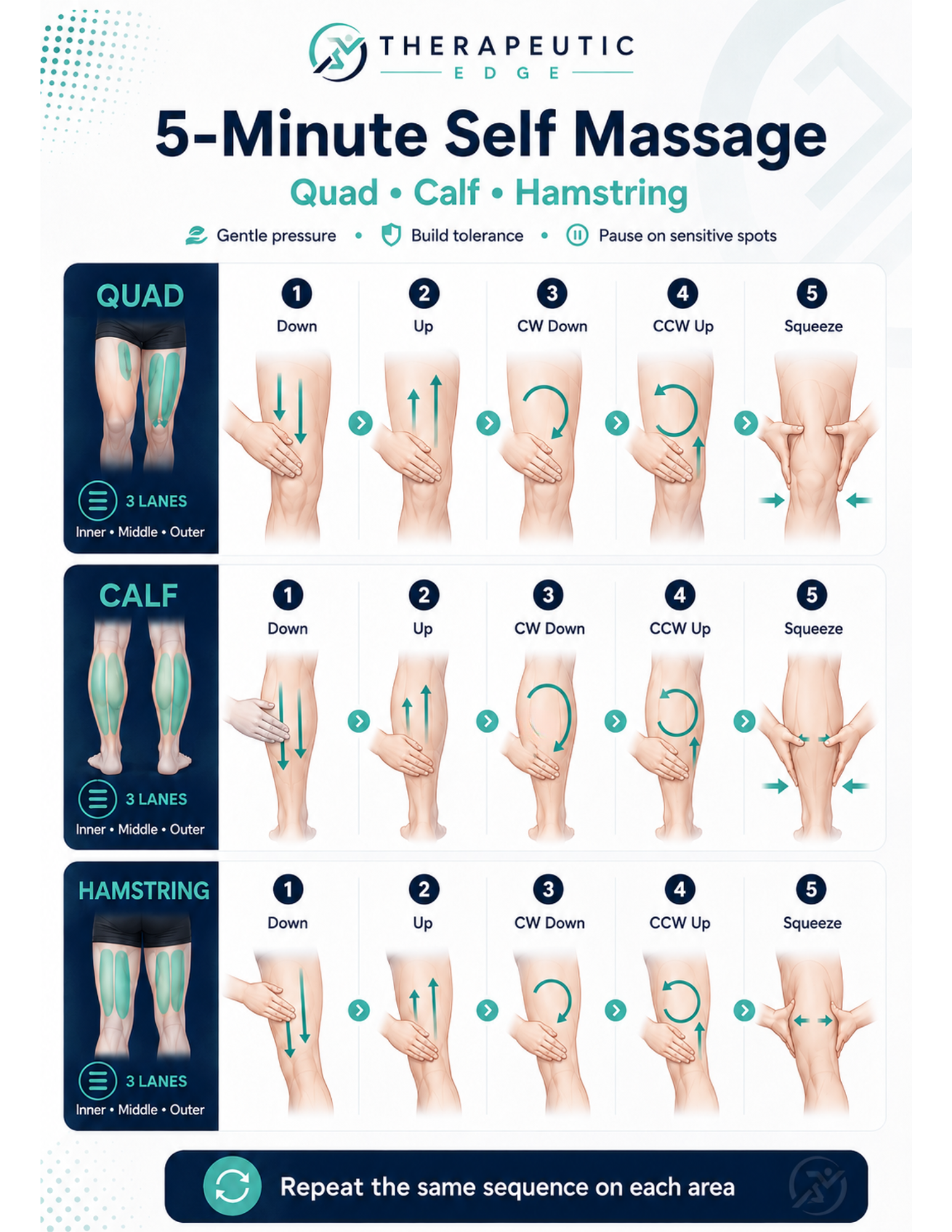
The Simple 5-Minute Self-Massage Sequence
For each muscle, break the area into 3 lanes:
- Inside lane
- Middle lane
- Outside lane
You do not need to be perfect. Think of this as a simple map so you are not randomly rubbing the same spot over and over.
The Sequence
- Linear strokes down: Use 5–10 gentle strokes down each lane.
- Linear strokes up: Use 5–10 gentle strokes up each lane.
- Clockwise circles down: Use 5–10 gentle circles as you move down each lane.
- Counterclockwise circles up: Use 5–10 gentle circles as you move up each lane.
- Light squeezing: Finish with gentle squeezing through the muscle.
If this takes longer than 5 minutes at first, that is okay. You can shorten the number of strokes, focus on the stiffest area, or split the routine into smaller sections.
Area 1: Quadriceps
The quadriceps are the muscles on the front of your thigh. After total knee replacement, this area often feels tight, sore, swollen, or difficult to activate.
The quad matters because it helps you straighten the knee, walk with better control, get up from a chair, and manage stairs. When swelling and soreness are higher, the quad can feel like it does not want to work normally.
Start above the knee and work through the thigh without pressing directly on the incision.
How to massage the quad
- Break the quad into inside, middle, and outside lanes.
- Use gentle linear strokes down each lane for 5–10 strokes.
- Repeat with gentle strokes up each lane for 5–10 strokes.
- Use clockwise circles as you move down each lane.
- Use counterclockwise circles as you move back up each lane.
- Finish with light squeezing through the thigh muscle.
This can be especially helpful before quad sets, straight leg raises, heel slides, short walks, or other knee replacement exercises.
Area 2: Calf
The calf can feel stiff after total knee replacement because walking often changes during recovery. You may be taking shorter steps, using a walker or cane, avoiding full weight through the leg, or moving more cautiously.
Use a gentle touch here. The calf should not be aggressively dug into after knee replacement surgery.
How to massage the calf
- Break the calf into inside, middle, and outside lanes.
- Use gentle strokes down the calf for 5–10 strokes per lane.
- Repeat with gentle strokes up the calf for 5–10 strokes per lane.
- Use clockwise circles as you move down each lane.
- Use counterclockwise circles as you move back up each lane.
- Finish with light squeezing through the calf muscle.
Calf caution: If your calf is newly swollen, red, hot, very tender, or painful in a way that feels different from normal soreness, do not massage it. Contact your medical team.
Area 3: Hamstrings
The hamstrings are the muscles on the back of your thigh. After total knee replacement, they can become guarded when the knee is sore, swollen, or struggling to fully straighten.
Gentle hamstring massage can help the back of the thigh feel less tense and may make knee extension work feel more comfortable.
How to massage the hamstrings
- Break the back of the thigh into inside, middle, and outside lanes.
- Use gentle strokes down the hamstring for 5–10 strokes per lane.
- Repeat with gentle strokes up the hamstring for 5–10 strokes per lane.
- Use clockwise circles as you move down each lane.
- Use counterclockwise circles as you move back up each lane.
- Finish with light squeezing through the back of the thigh.
This area can be useful to work on before knee extension exercises, walking practice, or gentle mobility work.
How Hard Should You Press?
Start lighter than you think you need.
A good self-massage routine after total knee replacement should feel tolerable and calming. It should not feel like you are trying to force the muscle to release.
Use this simple pressure guide:
- Good: gentle pressure, mild soreness, warmth, or relaxation.
- Too much: sharp pain, increased guarding, bruising, throbbing, or symptoms that feel worse afterward.
- Best rule: your leg should feel the same or better when you finish, not more irritated.
If you find a sensitive area, do not dig into it. Slow down, lighten the pressure, breathe, and spend a little extra time there only if the area begins to calm down.
When Should You Use Self-Massage After Knee Replacement?
Self-massage works best when it has a purpose.
Good times to use this routine include:
- Before your knee replacement exercises.
- Before a short walk.
- After a busy day when the muscles feel guarded.
- When the leg feels stiff from sitting.
- Before bed if muscle tension makes it harder to get comfortable.
You do not need to do a long routine every time. Sometimes 1–2 minutes on the area that feels the most guarded is enough to help you move better.
What Self-Massage Should Not Replace
Self-massage can help the knee feel more comfortable, but it is not the whole recovery plan.
You still need the right amount of:
- Knee bending and straightening work.
- Quad activation.
- Walking practice.
- Strengthening.
- Swelling management.
- Progressive return to daily activity.
Think of self-massage as a preparation tool. It can help the leg feel more ready to move, but the movement and strengthening still matter.
When To Be More Cautious
Most stiffness and soreness after total knee replacement are part of the recovery process, but some symptoms deserve more caution.
Contact your medical team if you notice:
- New or rapidly increasing calf swelling.
- Calf warmth, redness, or significant tenderness.
- Sudden shortness of breath or chest pain.
- Fever, chills, or feeling unusually ill.
- Increasing redness, drainage, opening, or worsening pain around the incision.
- Swelling or pain that keeps getting worse instead of gradually settling.
Also avoid self-massage over skin that is irritated, open, infected, numb in a way that makes pressure hard to judge, or not fully healed.
Related Learning
Want to keep learning about this part of knee replacement recovery? These articles may help:
- Why Is My Knee Still Swollen After Knee Replacement?
- Why Does My Quad Feel Shut Down After Knee Replacement?
- How Do I Know If I’m Doing Too Much After Knee Replacement?
- How to Improve Knee Extension After Knee Replacement
- Why Walking Alone Is Not Enough After Knee Replacement
Want a More Structured Plan for Knee Replacement Recovery?
The Knee Replacement Recovery Guide gives you phase-by-phase exercise plans, progress check-ins, focus tracks, and guidance for adjusting your plan as your knee recovers.
Instead of guessing what to do each week, you can follow a clearer recovery path based on where you are in the process.
FAQ
Can I massage my knee after total knee replacement?
You can usually massage the muscles around the knee gently, but you should not massage directly over the incision until it is fully healed and cleared by your medical team. Focus on the quad, calf, and hamstring muscles instead of pressing directly on the surgical area.
When can I massage over my knee replacement incision?
Only massage over the incision once it is fully healed. That means the skin is closed, there are no scabs, no drainage, no open areas, and your surgeon or physical therapist has cleared you to begin scar massage.
Should self-massage after knee replacement hurt?
No. It may feel mildly tender in certain areas, but it should not feel sharp, intense, or painful. If your leg feels more irritated afterward, use less pressure or shorten the routine.
How often should I do this routine?
Many people do well using it once per day or before exercise when the leg feels stiff. You can also use a shorter version when one area feels especially guarded.
Can I use lotion?
Yes, if your skin is healed and your medical team has not given you restrictions. Avoid putting lotion directly on an incision that is not fully healed.
Can I use a massage gun after total knee replacement?
Be careful. Early after total knee replacement, hands are usually easier to control than a massage gun. If you use one later in recovery, avoid the incision, avoid bony areas, use a low setting, and ask your surgeon or physical therapist if it is appropriate for your situation.
What is the best time to use self-massage after knee replacement?
A good time is before exercise, before walking, after prolonged sitting, or when the leg feels guarded. The goal is to help the knee feel more comfortable and ready to move.
Looking for more knee replacement guidance? Browse Knee Replacement Resources.