After total knee replacement, the incision on the front of the knee can sometimes feel tight, sensitive, thick, or less mobile as it heals.
That tightness can make the front of the knee feel restricted during bending, straightening, walking, stairs, or exercise. Once the incision is fully healed, gentle scar massage may help improve comfort and help the skin and tissue around the scar move more freely.
The key phrase is once the incision is fully healed.
Scar massage is not something to rush. The goal is not to dig into the scar or force the tissue to loosen. The goal is to use gentle, controlled pressure to help the healed scar and surrounding skin tolerate movement in different directions.
Quick Answer
Scar massage after total knee replacement may help reduce tightness, improve comfort, and help the front of the knee move better once the incision is fully healed.
A simple routine includes gentle up-and-down strokes, side-to-side strokes, clockwise circles, and counterclockwise circles along the healed scar.
Do not massage over the incision if there are scabs, drainage, open areas, stitches, staples, increasing redness, or irritated skin. When in doubt, ask your surgeon or physical therapist before starting.
Roadmap PDF
Want the recovery timeline in one place?
Download the Total Knee Replacement Recovery Roadmap to see what usually matters most at each stage and when to progress, hold steady, or modify.
Watch: Scar Massage After Total Knee Replacement
This video walks you through the same scar mobility routine shown in the infographic below. Start only once the incision is fully healed, use gentle pressure, and stop if the skin feels irritated.
Key Takeaways
- Scar massage should only begin once the incision is fully healed.
- The goal is gentle scar mobility, not aggressive pressure.
- Use up-and-down strokes, side-to-side strokes, clockwise circles, and counterclockwise circles.
- Work gradually from the top of the scar toward the bottom.
- Pressure should feel comfortable and controlled, not sharp or painful.
- Stop if the skin becomes irritated, red, painful, warm, or swollen.
Why the Scar Can Feel Tight After Total Knee Replacement
After total knee replacement, the incision and surrounding tissues go through a healing process. Early on, the priority is protecting the incision and allowing the skin to close. Over time, the scar may start to feel firmer, tighter, thicker, or less mobile.
That does not automatically mean something is wrong. Healing tissue often feels different than normal skin.
But if the scar and surrounding skin do not move well, the front of the knee may feel tight when you bend or straighten the knee. Some people notice pulling, pressure, sensitivity, or a restricted feeling around the incision area.
Gentle scar massage may help by encouraging the healed skin and tissue to move in different directions. This can make the front of the knee feel more comfortable before exercise, walking, or mobility work.
The goal is not to “break up scar tissue” with force. The goal is to gradually build comfort, mobility, and tolerance around the healed incision.
Before You Start: The Incision Must Be Healed
Important Incision Rule
Only start scar massage once your incision is fully healed.
That means the skin is closed, there are no scabs, no drainage, no open areas, no staples, no stitches, and no irritated skin. If you are not sure whether your incision is ready, ask your surgeon, physical therapist, or medical team first.
This matters because massaging too early can irritate the incision or interfere with healing. Scar massage is a later-stage strategy. It should not be used on a wound that is still closing.
Once the incision is fully healed and you are cleared to begin, keep the pressure gentle and monitor how the skin responds.
How to Use the Infographic
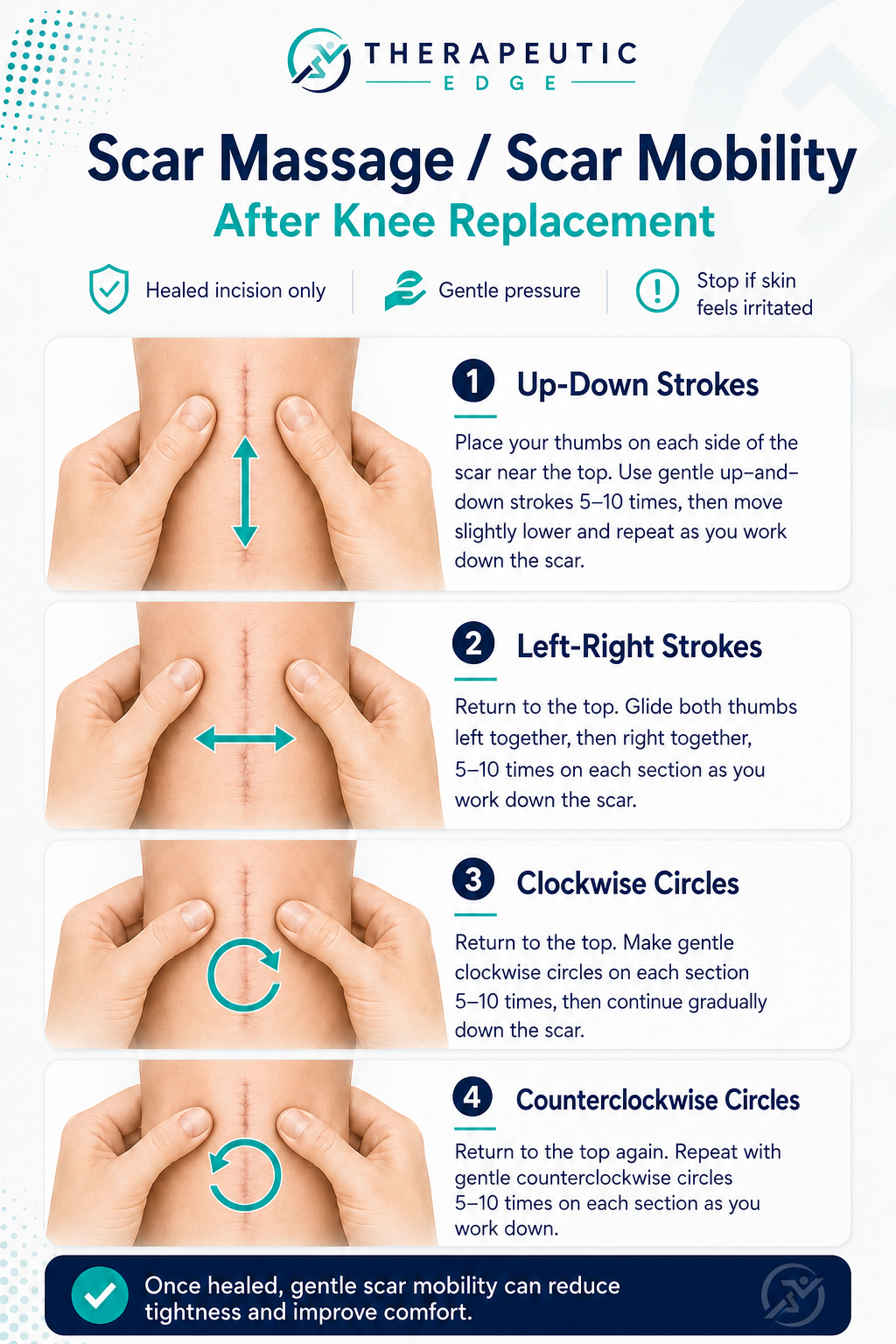
The infographic below gives you a simple visual guide for scar massage after total knee replacement.
The routine has four parts:
- Up-and-down strokes: gentle vertical movement along the scar.
- Left-right strokes: gentle horizontal movement across the scar area.
- Clockwise circles: small circles as you work down the scar.
- Counterclockwise circles: small circles in the opposite direction as you work down the scar.
The Simple Scar Massage Routine
Find a comfortable position where your knee can relax. You may prefer sitting with the leg supported or lying down with the knee resting comfortably.
Use clean hands. If your skin is fully healed and your medical team says it is appropriate, you may use a small amount of lotion or vitamin E oil to reduce friction.
For each movement, start near the top of the scar and gradually work your way down.
The Routine
- Up-and-down strokes: Place your thumbs on each side of the scar near the top. Use gentle up-and-down strokes 5–10 times, then move slightly lower and repeat as you work down the scar.
- Left-right strokes: Return to the top. Place your thumbs on each side of the scar and gently glide left and right 5–10 times, then move lower and repeat.
- Clockwise circles: Return to the top. Use gentle clockwise circles 5–10 times on each section, gradually working down the scar.
- Counterclockwise circles: Return to the top again. Use gentle counterclockwise circles 5–10 times on each section, gradually working down the scar.
The movement should be small and controlled. You are not trying to force the scar to move. You are helping the healed skin and tissue become more comfortable moving in different directions.
Step 1: Up-and-Down Strokes
Start at the top of the scar. Place your thumbs on each side of the incision, not directly digging into the scar.
Gently move the skin and tissue up and down for 5–10 strokes. Then move slightly lower and repeat. Continue this pattern until you have worked down the length of the scar.
How to do it
- Start near the top of the healed scar.
- Place your thumbs on each side of the scar.
- Use gentle up-and-down strokes.
- Perform 5–10 strokes in one area.
- Move slightly lower and repeat until you reach the bottom.
This direction helps the scar and surrounding skin tolerate movement along the length of the incision.
Step 2: Left-Right Strokes
After finishing the up-and-down strokes, return to the top of the scar.
Place your thumbs on each side of the scar and gently glide the tissue left and right. Perform 5–10 strokes in one area, then move slightly lower and repeat as you work down the scar.
How to do it
- Return to the top of the healed scar.
- Place your thumbs on each side of the scar.
- Gently move the skin and tissue left and right.
- Perform 5–10 strokes in one area.
- Move slightly lower and repeat until you reach the bottom.
This direction helps the scar and surrounding skin tolerate movement across the incision area.
Step 3: Clockwise Circles
Next, return to the top again and use small clockwise circles.
Keep the circles gentle. Perform 5–10 circles in one area, then move slightly lower and continue until you have worked down the scar.
How to do it
- Start again near the top of the healed scar.
- Place your thumbs on each side of the scar.
- Use small clockwise circles.
- Perform 5–10 circles in one area.
- Move slightly lower and repeat as you work down the scar.
This gives the healed scar tissue a circular movement input instead of only moving in straight lines.
Step 4: Counterclockwise Circles
Finally, repeat the circular motion in the opposite direction.
Return to the top of the scar and use small counterclockwise circles. Perform 5–10 circles in one area, move slightly lower, and repeat until you reach the bottom.
How to do it
- Return to the top of the healed scar.
- Place your thumbs on each side of the scar.
- Use small counterclockwise circles.
- Perform 5–10 circles in one area.
- Move slightly lower and repeat until you reach the bottom.
Working in both circular directions helps the scar and surrounding skin become more comfortable with movement in multiple directions.
How Hard Should You Press?
Use gentle pressure.
Scar massage after total knee replacement should not feel sharp, aggressive, or painful. The skin may feel tight or mildly sensitive at first, but it should not feel like you are irritating the area.
Use this simple pressure guide:
- Good: gentle pressure, mild tightness, improved comfort, or the skin feeling easier to move after a few passes.
- Too much: sharp pain, burning, throbbing, increased redness, warmth, swelling, or lingering soreness afterward.
- Best rule: the scar and skin should feel the same or better when you finish, not more irritated.
If the scar feels sensitive, start with lighter pressure, fewer strokes, and shorter sessions. You can build tolerance over time.
When Should You Use Scar Massage?
Scar massage works best when it is done consistently and gently.
Good times to use this routine include:
- Before knee bending exercises.
- Before knee straightening exercises.
- Before kneecap mobility work, if appropriate.
- After a shower, once the skin is dry.
- When the scar feels tight but the skin is not irritated.
You do not need to spend a long time on it. A short, gentle routine is usually better than an aggressive one.
What Scar Massage Should Not Replace
Scar massage can help the healed incision area feel more mobile, but it is not the whole recovery plan.
You still need the right amount of:
- Knee bending and straightening work.
- Quad activation.
- Walking practice.
- Strengthening.
- Swelling management.
- Progressive return to daily activity.
Think of scar massage as one tool. It may help reduce tightness around the front of the knee, but the knee still needs movement, strength, and gradual loading to recover well.
When To Be More Cautious
Scar massage should not make the knee or incision area feel worse.
Do not perform scar massage and contact your medical team if you notice:
- Open areas along the incision.
- Scabs, drainage, or bleeding.
- Increasing redness, warmth, or swelling around the incision.
- New or worsening pain around the scar.
- Skin that feels irritated, fragile, or inflamed.
- Fever, chills, or feeling unusually ill.
- New or rapidly increasing calf swelling, calf warmth, or calf tenderness.
Also stop if the skin becomes more sensitive, red, or irritated after the routine. In that case, use less pressure, reduce the time, or ask your physical therapist to check your technique.
Related Learning
Want to keep learning about this part of knee replacement recovery? These articles may help:
- Kneecap Mobility After Total Knee Replacement: A Simple 1-Minute Routine
- Self-Massage After Total Knee Replacement: A Simple 5-Minute Routine
- Why Is My Knee Still Swollen After Knee Replacement?
- How to Improve Knee Extension After Knee Replacement
- How Do I Know If I’m Doing Too Much After Knee Replacement?
FAQ
When can I start scar massage after total knee replacement?
You should only start scar massage once the incision is fully healed and your medical team says it is appropriate. Do not massage over scabs, drainage, open areas, stitches, staples, or irritated skin.
Does scar massage after knee replacement hurt?
No. Scar massage may feel mildly tight or sensitive, but it should not feel sharp, painful, burning, or irritating. Use gentle pressure and stop if the skin feels worse afterward.
How often should I do scar massage after knee replacement?
Many people tolerate a short, gentle routine once or twice per day once the incision is healed, but your exact frequency should follow your surgeon or physical therapist’s guidance.
Can scar massage help knee bending after total knee replacement?
Scar massage may help the front of the knee feel less tight, which can make bending exercises feel more comfortable. It should not replace your full rehab plan, including knee motion, swelling management, walking, quad activation, and strengthening.
Should I use lotion or oil for scar massage?
You may be able to use lotion or vitamin E oil once the incision is fully healed, but follow your medical team’s guidance. Do not apply lotion or oil to an incision that is still open, scabbed, draining, or irritated.
What should I do if my scar gets red or irritated after massage?
Stop the routine and let the skin calm down. Next time, use less pressure, fewer strokes, or a shorter session. If redness, warmth, swelling, drainage, or pain persists, contact your medical team.
Is scar massage the same as kneecap mobility?
No. Scar massage focuses on improving the mobility of the healed scar and surrounding skin. Kneecap mobility focuses on gently gliding the patella, or kneecap. Both may be useful after total knee replacement, but they are different techniques.
Looking for more knee replacement guidance? Browse Knee Replacement Resources.